Scale control. Not water softening.
A different approach to protecting professional equipment: act on limescale as it forms, and on deposits already inside your machines, rather than remove hardness minerals.
How CITRYNE works
CITRYNE® uses citrate-based treatment to help keep calcium and magnesium from forming hard limescale deposits. It controls scale without removing the hardness minerals from your water. It also acts on scale that has already formed inside your equipment.
- Chelation, not softening — the metal ions that cause hard water, principally calcium and magnesium, are bound by the citrate in our FDA-approved formulation and stay soluble, unable to bond.
- Pressure-fed dosing — the cartridge uses line pressure to release exactly the right amount of citrate into the water. No water is wasted and no electricity is needed.
- Removes and prevents — calcium carbonate becomes calcium citrate, so scale cannot bond to pipes or equipment, and pre-existing build-up is gradually removed.
- Hardness minerals stay in the water, preserving the taste and water quality your equipment is designed for.
- Correct system selection depends on water quality, equipment and usage.
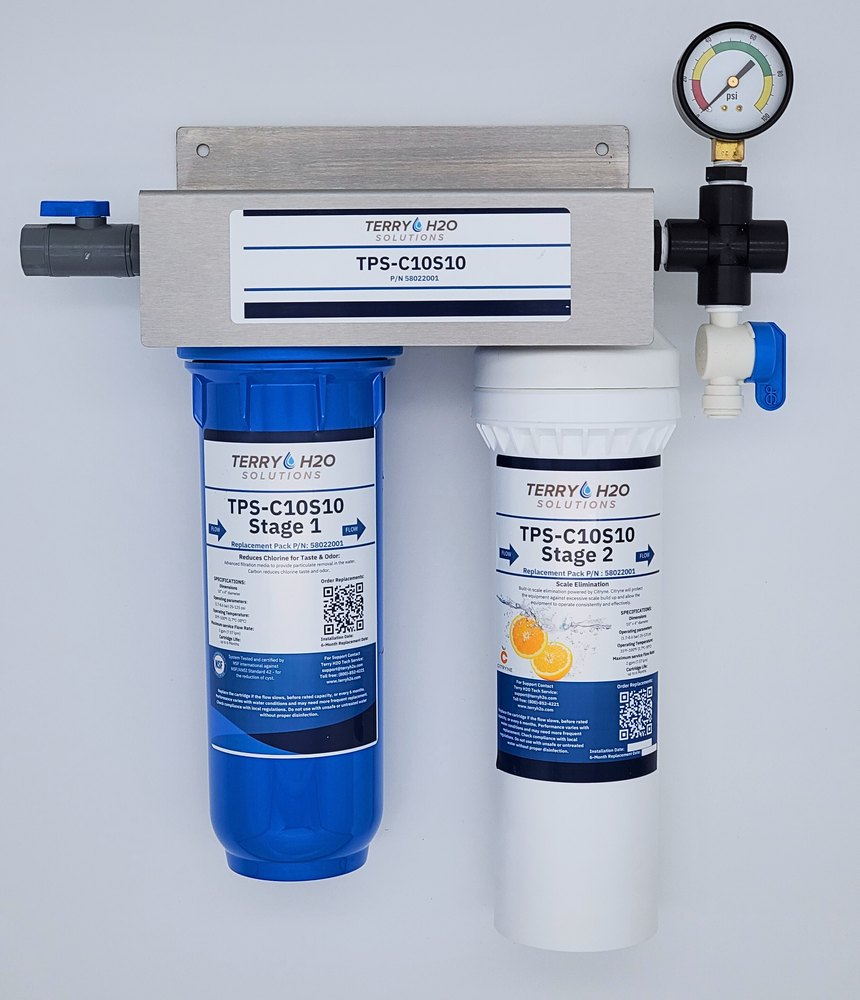
It also works on scale that is already there.
CITRYNE® does not only stop new limescale forming. It also acts on deposits that have already built up inside your equipment, helping to loosen them and carry them away — so heat exchangers, boilers and spray arms can work closer to how they were designed to.
Results depend on how long scale has been building up, your water and the equipment involved.
What limescale really costs you.
Scale rarely fails loudly. It builds quietly, and the costs add up long before a machine stops working.
Higher energy bills
scale on heating elements forces equipment to work harder for the same result.
Breakdowns and call-outs
blocked valves, scaled probes and overheated elements mean unplanned service visits.
Downtime
a machine out of action during service costs more than the repair itself.
Four treatments. Different jobs.
Compare the treatment, not just the filter name. The right choice depends on your equipment and local water.
| CITRYNE® scale control | Carbon-only filtration | Ion-exchange cartridge | Reverse osmosis | |
|---|---|---|---|---|
| Prevents new scale | Yes | No | Yes | Yes |
| Acts on existing scale | Yes, gradually | Not a descaling treatment | Not a descaling treatment | Not a descaling treatment |
| Reduces dissolved hardness | No | No | Yes — depends on design and bypass | Yes |
| Typical use | Scale protection for ice, steam, cooking and washing equipment. | Chlorine, taste and odour reduction; particle filtration depends on the cartridge. | Hardness reduction with capacity and bypass matched to the water and appliance. | Mineral reduction where a controlled water profile is needed, such as specialist espresso. |
General treatment comparison, not a ranking of BRITA, BWT or European WaterCare products. CITRYNE is not present in every Terry system: separate scale-inhibitor and RO models work differently. Check the chosen model’s specification.
Your water questions, answered.
What does the carbon stage do?
Carbon reduces chlorine and unwanted tastes and odours. Particle removal depends on the cartridge rating. It does not remove dissolved hardness or, on its own, prevent hardness scale. Confirm the cartridge identity, order and rating for your model.
Is CITRYNE phosphate-free?
Yes. CITRYNE is phosphate-free.
How often do the filters need changing — and who can change them?
Every six, nine or twelve months depending on your water hardness — or sooner if the rated capacity is reached or the flow slows. In two-stage systems both cartridges are changed together. No specialist is needed: anyone on site can change the cartridges in minutes.
Specifications and evidence matter.
Certification and food-contact claims must be checked against the exact model and supporting certificate or listing. Request the documentation for your chosen system; range-wide NSF/ANSI, WRAS or EU compliance claims are not assumed here.
When should the cartridges be changed?
Water flow, total capacity and replacement time are three different things.
- Flow rate · litres per minute
- A rate such as 7.6 L/min describes how quickly water can pass through a system. It is not the total amount it can treat before replacement.
- Total capacity · litres treated
- Total capacity is the volume a system treats before replacement. The specifications with each system give a capacity guide in litres, worked out from its maximum flow and your water hardness: very hard water uses about half of it, hard water about three quarters and moderate or soft water the full figure.
- Service interval · months
- Terry’s hardness lookup sets the starting interval: six months in very hard water, nine in hard water and twelve in moderate or soft water. Heavy daily use can use up the scale-control capacity sooner — change at the interval, at the rated capacity or when the flow slows, whichever comes first. In two-stage systems, both cartridges are changed at the same time.
Your water hardness sets the interval
| Water hardness | Typical hardness | Service interval |
|---|---|---|
| Very hard | ≥ 285 mg/l CaCO₃ | 6 months |
| Hard | 190–284 mg/l CaCO₃ | 9 months |
| Moderate / soft | < 190 mg/l CaCO₃ | 12 months |
The capacity guide with each system shows the litres it treats in your hardness band.
Check your local water supplier’s hardness report to set the starting interval, and tell us your daily water use so we can confirm the right system and change date.
Discuss water use and replacementProtected by three US patents
The Terry pressure-fed chemical release system is protected by US patents 7,297,257 (mechanical release system and pressure vessel), 9,540,267 (feeding head with time-release pouch) and 9,850,153 (systems that prevent or remove hard water build-up). CITRYNE® is a registered trade mark; a trade mark protects the name, not the chemistry.
Technical informationLess downtime starts with better water.
Let’s find the right Terry H2O solution for your equipment.